Payroll growth came in well above expectations, but the more useful story is where hiring is picking up—and why a stronger headline doesn’t mean every recruiter or job seeker is experiencing the same market.
If you work in staffing and recruiting, October’s jobs report may sound familiar. Some searches are moving faster. Candidates who were difficult to reach are responding again. Employers are making hires after fewer interviews.
At the same time, other searches are still paused, clients are taking their time, and many workers are dealing with reduced hours or part-time work they didn’t choose.
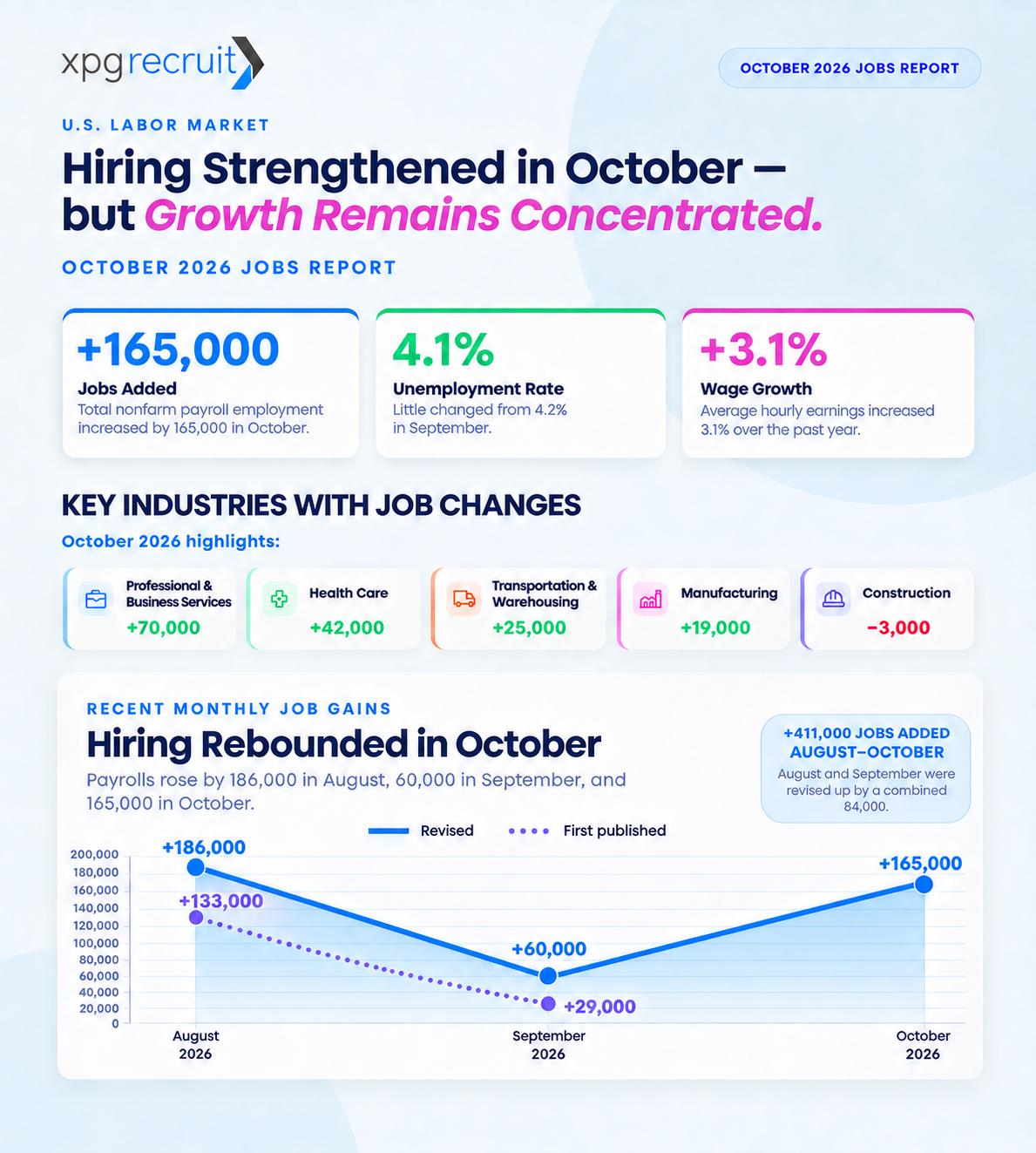
The latest Bureau of Labor Statistics report recorded 165,000 new jobs in October, compared with an average monthly gain of 48,000 over the prior 12 months. Unemployment edged down from 4.2% to 4.1%. Revisions also added 84,000 jobs to the August and September totals.
That is a much stronger report than September’s. But the most useful takeaway for staffing and recruiting leaders isn’t simply that hiring improved. It’s that the improvement is showing up in particular sectors and hiring conversations, while other parts of the labor market remain strained.
The Summer Numbers Look Different Now
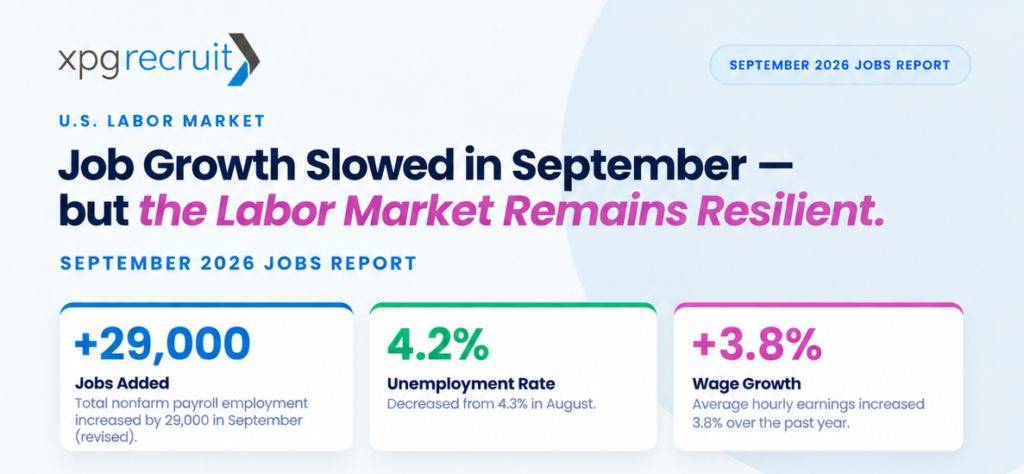
Our September jobs report analysis focused on a choppy sequence: July lost 10,000 jobs, August added 133,000, and September added 29,000. The new report revised August up to 186,000 and September to 60,000. October then added another 165,000.
That changes the picture we had a month ago. The recent pattern now looks more like a brief slowdown followed by stronger gains than a weak summer followed by one isolated rebound.
It’s a meaningful shift, and it supports the idea that hiring activity has been building in some areas. But it still doesn’t tell us that companies across the board are ready to hire aggressively. As we wrote in our August analysis, a stronger payroll number can change the direction of the conversation without proving that demand is rising everywhere.
For recruiters, that distinction matters. One client may be ready to reopen a search while another is still waiting for budget approval. A stronger national report can reflect genuine momentum and still fail to describe what’s happening with a particular client, role, or market.
The Staffing Signal Is in the Industry Details
Professional and business services added 70,000 jobs in October, well above its average monthly gain of 15,000 over the prior year. Health care added 42,000 jobs, transportation and warehousing added about 25,000, and manufacturing added 19,000.
One detail may be especially relevant to staffing firms: temporary help services added 18,600 jobs in October after losing 5,600 in September. That’s a notable monthly improvement, though one month doesn’t establish a sustained trend. Employment also changed little in many other major industries, including construction, retail, information, financial activities, leisure and hospitality, and government.
For recruiters, these numbers are more useful as a map than as a verdict. They suggest where hiring may be picking up and where a search is more likely to need a specific client or industry explanation.
They also help explain why recruiters can hear very different things from people working in the same labor market. A firm recruiting in engineering or skilled trades may be seeing more demand, while a recruiter focused on a slower-moving sector may still be dealing with cautious clients and long decision cycles. The national number captures the total. The industry details help explain the variation.
What We’re Hearing From Recruiters
The October data also gives context to the feedback we included in the latest edition of The Talent Brief. Recruiters have described more demand for recruiter and account-management talent, fewer searches staying paused, and occasional hires moving forward after just one interview.
They’re also hearing back from candidates who didn’t respond to outreach earlier in the year, particularly about remote opportunities. In Skilled Trades and Engineering, recruiters are seeing some of the clearest increases in demand, with activity in IT as well.
That kind of movement changes the daily work. When a client is ready to move quickly, the recruiter has less room to let feedback sit for a week. When a candidate is considering several opportunities, a slow or unclear process can cost the client someone they wanted to hire. Recruiters have reported counteroffers becoming more common and some candidates weighing five or more opportunities at once.
This fits with the pattern we described in “Why Hiring Feels Different—Even Though the Headlines Haven’t Changed Much”: hiring activity can change before the broader market feels strong. A paused search is reopened. An old candidate responds. A hiring manager moves from “let’s keep talking” to “we want to make an offer.”
Those moments don’t mean every search is moving quickly. They do help show what improving confidence can look like in practice.
A Lower Unemployment Rate Doesn’t Mean Less Strain
There’s another part of the report that deserves attention. Unemployment edged down to 4.1%, but the broader U-6 underemployment rate rose from 7.6% to 7.9%. At the same time, the number of people working part time for economic reasons increased by 339,000 to 4.8 million. These are people who would prefer full-time work but are working part time because their hours were cut or they couldn’t find full-time work.
That isn’t a contradiction. The unemployment rate counts people without a job who are actively looking for work. U-6 also accounts for people who are underemployed or marginally attached to the workforce. In October, much of the increase in economic part-time work came from people working reduced hours because of slack work or business conditions.
For recruiters, this is a reminder that a labor market can create more jobs while many workers still feel insecure. There may be more people looking for full-time work, but that doesn’t automatically mean there is an immediate match for a specialized role. Skills, location, compensation, schedule, and the kind of work someone wants still shape whether a candidate is right for a search.
It also helps explain why the experience of the market can differ so much from the headline. One candidate may be choosing between several offers. Another may be looking for a full-time position after their hours were cut. Both realities can exist at once.
What October Means for Staffing Firms
October gives us stronger evidence that hiring is moving in the right direction. Payroll growth accelerated, August and September were revised upward, and temporary help services returned to growth. Recruiters are also reporting more active searches, more candidate responses, and more competition for some experienced talent.
But the report doesn’t show a uniform hiring surge. Many industries changed little, and the increase in underemployment is a reminder that more payroll jobs don’t automatically translate into greater security or opportunity for every worker.
That’s why we continue to look at both the data and what recruiters are hearing. As we wrote in “The Market Rarely Rings a Bell”, changes in hiring often appear first in ordinary moments: a client reopening a search, a candidate replying to an old message, or a process moving ahead faster than it did a few months earlier.
October gives those signals more weight. It doesn’t mean every market has turned, but it does suggest that the firms paying attention to where demand is actually building may be better positioned to respond.
Source: U.S. Bureau of Labor Statistics — October 2026 Employment Situation