August delivered a stronger payroll gain than recent months, while revisions to June and July improved the picture of the summer labor market. For staffing and recruiting leaders, the details point to a market that is improving unevenly rather than accelerating across the board.
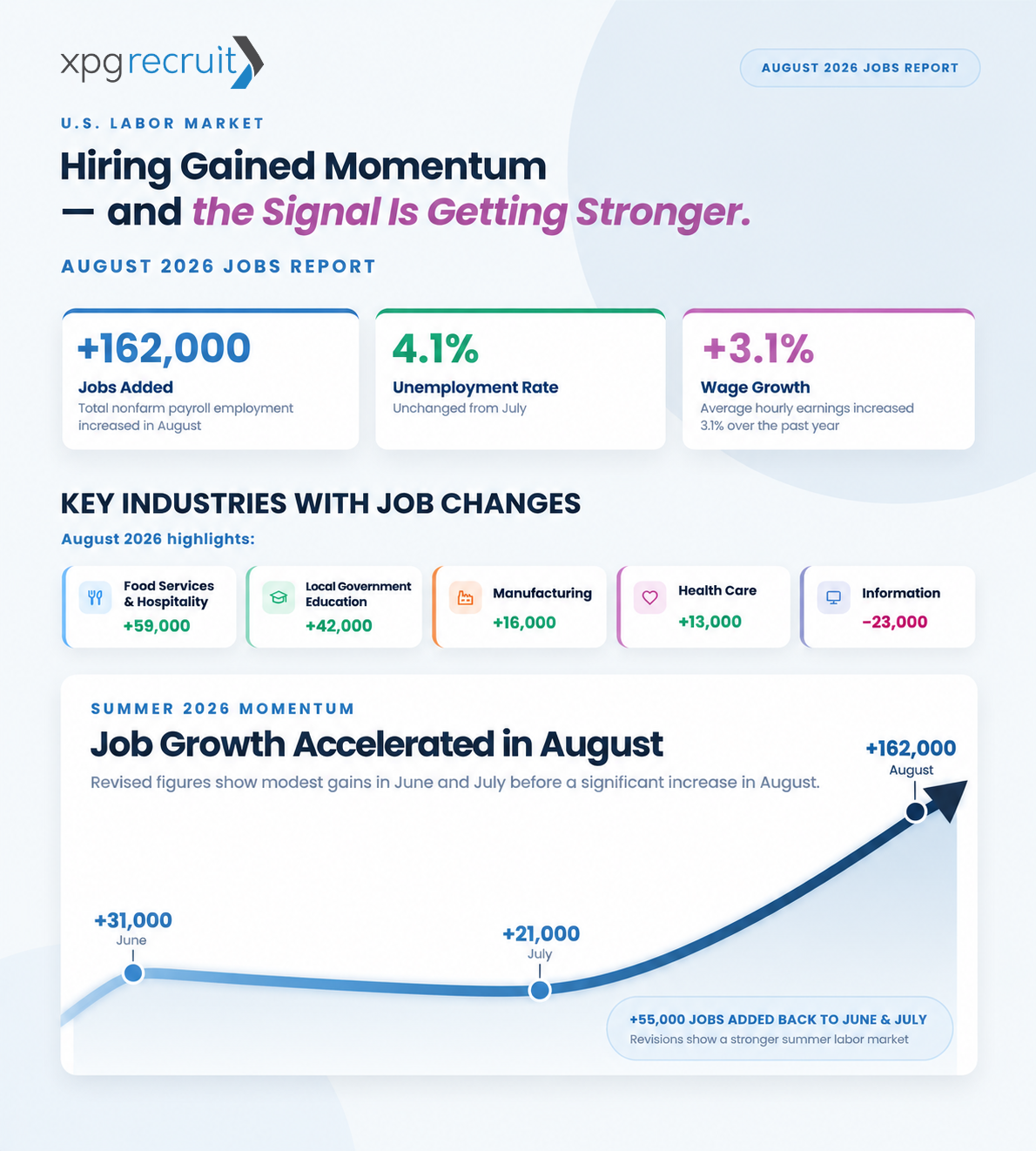
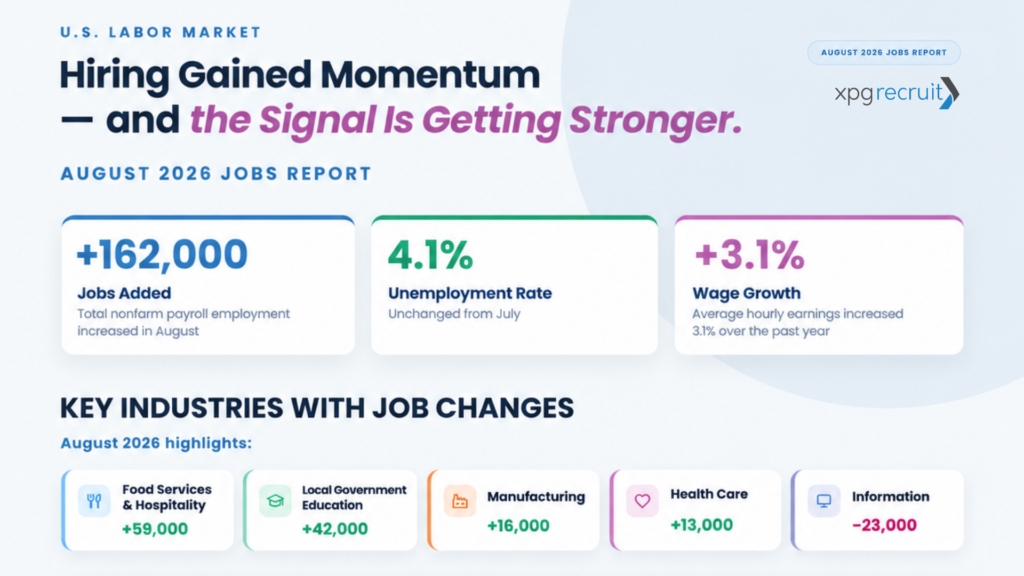
The August employment report showed a notable improvement in job growth. Total nonfarm payroll employment increased by 162,000, well above the average monthly gain of 31,000 over the prior 12 months, while the unemployment rate remained unchanged at 4.1%. Labor force participation also edged up to 61.6%, although it remains below where it stood at the beginning of the year.
Revisions to prior months also changed the picture of the summer labor market. June payroll growth was revised from 20,000 to 31,000, while July was revised from a loss of 23,000 jobs to a gain of 21,000. Combined, those revisions added 55,000 jobs back to June and July.
For staffing and recruiting leaders, that distinction matters because it changes how we interpret the direction of the market. Rather than a contraction in July followed by a sudden August rebound, the updated numbers show modest employment growth continuing through the summer before strengthening in August. That broader trend is consistent with what we’ve been watching throughout 2026. Our expectation entering the year was that improvement would be gradual and uneven, with individual industries, companies, and functions beginning to move at different times. August offers stronger evidence of that progression, but the underlying data still suggests a selective market rather than a broad hiring surge.
Hiring Improved, but Growth Was Concentrated
The August gains were encouraging, but they were not evenly distributed. Food services and drinking places added 59,000 jobs, while local government education added 42,000. Manufacturing continued its upward trend with 16,000 jobs added, bringing employment in the sector 58,000 above its December 2025 low. Health care added another 13,000 jobs, although growth remained below its average pace over the prior year.
Other sectors were flat or moved in the opposite direction. The information industry lost 23,000 jobs, with declines across computing infrastructure and data processing, publishing, and broadcasting. Employment showed little change in professional and business services, financial activities, retail trade, transportation and warehousing, and several other major industries.
For staffing firms, a stronger overall jobs number does not necessarily translate into stronger demand across every vertical. A firm serving manufacturing clients may be experiencing a very different market than one concentrated in information or another flat or declining sector. Even within growing industries, demand can vary by function, geography, and skill set. In a market like this, specialization becomes particularly valuable because it allows firms to identify where employers are actually investing rather than relying on the direction of the broader market.
The Revisions Put Recent Weakness in Perspective
July initially appeared much weaker, with payroll employment reported down 23,000. The August revision now puts July at +21,000, while June has been revised to +31,000. The revised figures still reflect slow growth, but they show greater stability than the original reports suggested.
For staffing and recruiting, this reinforces why one month of data should not be interpreted in isolation. Hiring behavior often changes gradually, and employers may reopen searches, approve critical positions, or become more decisive before those changes translate into stronger payroll growth. Looking at revisions alongside several months of data provides a better indication of whether those individual decisions are beginning to develop into a broader trend.
Other Measures Also Showed Improvement
Several other parts of the August report were encouraging. The number of people working part time for economic reasons fell by 414,000 to 4.4 million, meaning fewer workers were in part-time roles because their hours had been reduced or they could not find full-time employment. Labor force participation edged up to 61.6%, while unemployment held steady at 4.1%.
Wage growth also continued, with average hourly earnings increasing 0.3% in August and 3.1% over the past year. Taken together, these measures point to a labor market that remains relatively stable while showing some improvement, rather than one experiencing broad-based acceleration.
What We’re Seeing in Staffing and Recruiting
The August data also provides useful context for what we’ve been hearing in our own conversations. Employers remain thoughtful about adding headcount, but we’re continuing to see movement around business-critical hires, replacement positions, succession needs, and revenue-generating roles. We’re also continuing to see experienced candidates become more receptive to conversations, adding another layer of movement to a market that spent much of the past year defined by caution.
Searches that might have remained exploratory earlier in the year are becoming more actionable, while hiring managers are increasingly focused on securing the right candidate when they find one. These changes don’t suggest the staffing market has returned to broad-based growth, but they do suggest that opportunity is becoming more visible in specific areas.
For staffing firms, understanding where that demand is developing—and maintaining strong relationships with clients and candidates before a need becomes urgent—remains particularly important in a selective market.
Looking Ahead
The August report provides a more encouraging picture than the initial data from earlier in the summer. Payroll growth strengthened to 162,000, unemployment remained stable, and revisions added 55,000 jobs back to June and July. At the same time, growth remains uneven across industries, making it difficult to describe the labor market with a single headline.
For staffing and recruiting leaders, that makes it important to continue watching both the broader data and the activity occurring within individual markets. Employment reports show what has already happened at scale, while client conversations, search activity, and candidate engagement provide additional context around where demand may be developing.
So far, August supports the outlook we’ve maintained throughout 2026: the market is improving, but not everywhere and not at the same pace. The next several months will tell us whether August’s stronger hiring develops into a broader trend. For now, the combination of stronger payroll growth, improved revisions, and the activity we’re seeing firsthand gives us reason to remain cautiously optimistic.