September delivered little change in employment across the major industries, while revisions weakened the picture of the summer labor market. For staffing and recruiting leaders, the latest report reinforces a theme we’ve been watching throughout 2026: improvement remains uneven, and one strong month doesn’tnecessarily signal a broader shift.
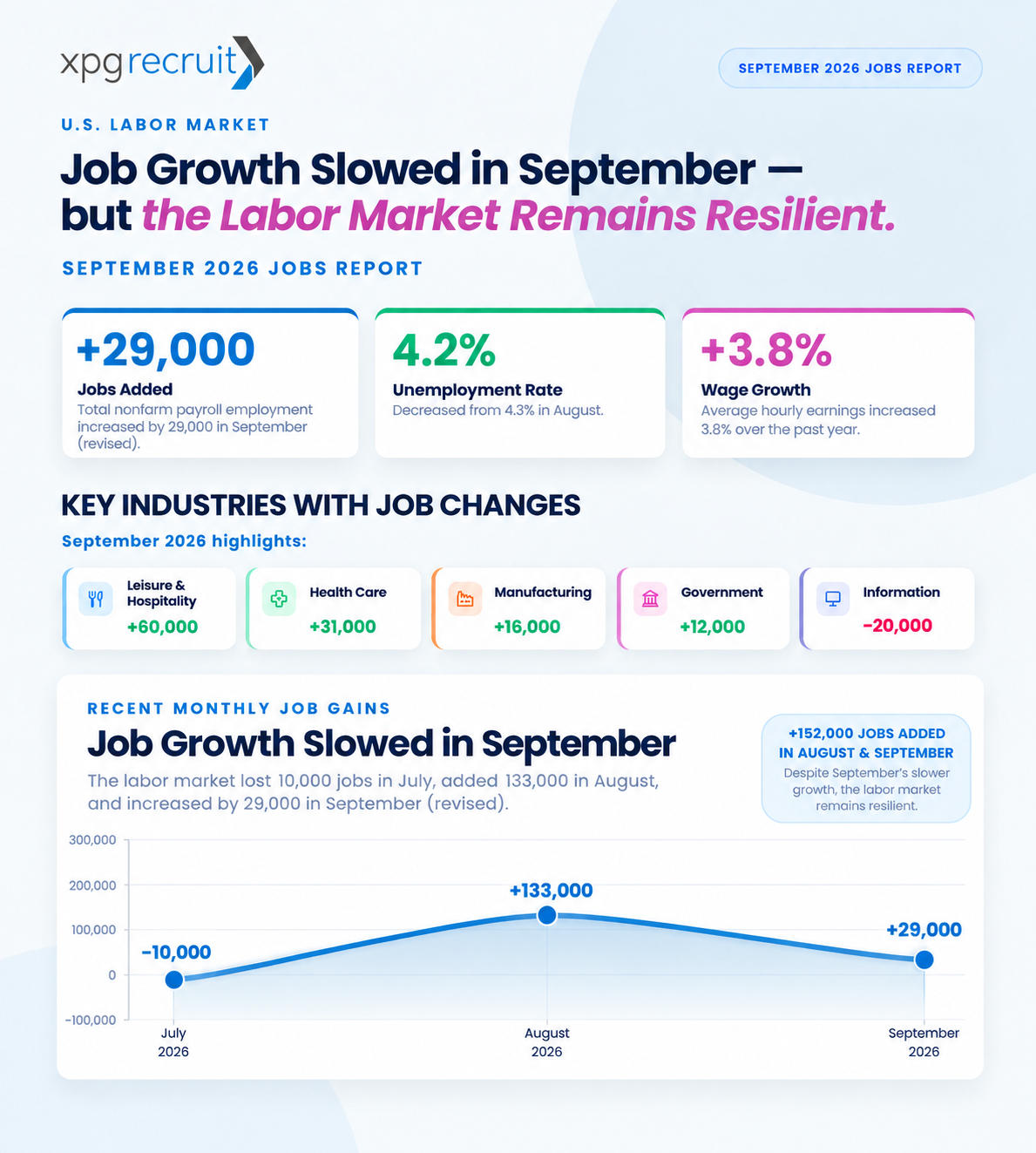
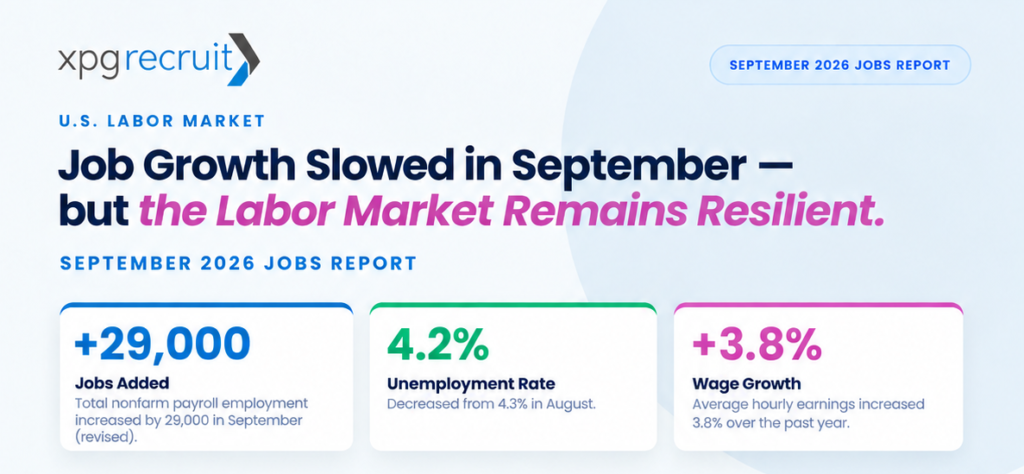
The September employment report brought hiring growth back to a much slower pace. Total nonfarm payroll employment increased by just 29,000, compared with an average monthly gain of 45,000 over the prior 12 months, while the unemployment rate changed little at 4.2%. Employment also changed little across every major industry tracked by the Bureau of Labor Statistics.
But September’s headline number isn’t the only important part of this report. Revisions to July and August changed the picture of the summer labor market once again. July was revised from a gain of 21,000 jobs to a loss of 10,000, while August was revised from +162,000 to +133,000. Together, employment in those two months was 60,000 lower than previously reported.
That puts the stronger August report into better perspective. Last month, we wrote that August could represent growing momentum after modest gains in June and July. The revised numbers now show a more uneven progression: a small contraction in July, a significant increase in August, and much slower growth again in September.
For staffing and recruiting leaders, that volatility matters. The labor market continues to produce signs of stability and opportunity, but the data isn’t yet showing a consistent acceleration in hiring.
September Was Quiet Across Most Industries
One of the most notable parts of the September report is how little movement occurred across major industries.
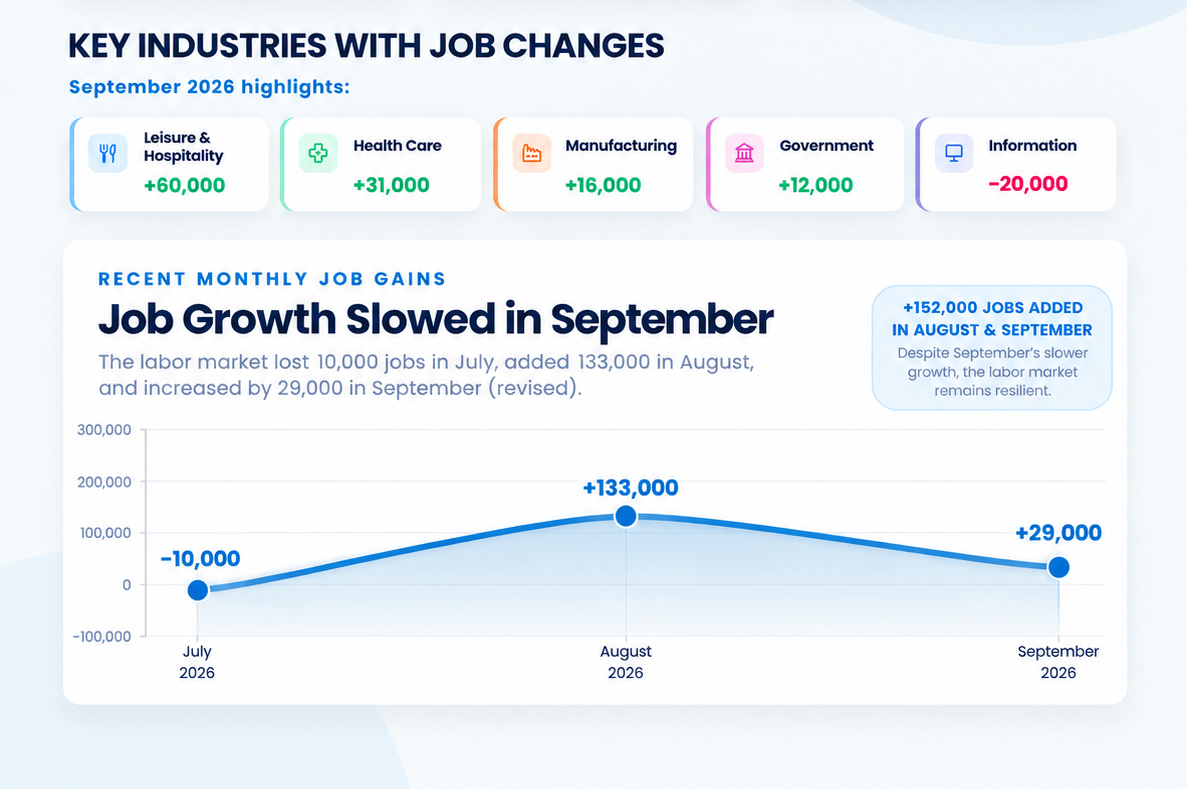
Health care continued to trend upward, adding 17,000 jobs, although that was roughly half its average monthly gain of 33,000 over the prior year. Construction added 11,000, while manufacturing added 9,000. Manufacturing employment is now 72,000 above its December 2025 low, making it one area where gradual improvement continues to be visible.
Financial activities declined by 7,000, although BLS characterized employment in the sector as little changed for the month. More broadly, employment also showed little change in professional and business services, information, retail, transportation and warehousing, leisure and hospitality, government, and several other major industries.
For staffing firms, the lack of broad industry growth helps explain why the market can still feel slow even when individual companies are hiring. There are opportunities, but they’re developing within a labor market where employers remain selective about where they add headcount. That can create a very different recruiting environment from one in which demand is rising simultaneously across multiple industries.
The Revisions Matter Again
If there is one lesson from the employment reports this summer, it’s that the first number isn’t necessarily the final story.
July was initially reported as a loss of 23,000 jobs. It was then revised to a gain of 21,000. This month’s report revises it again, this time to a loss of 10,000. August’s initially reported gain of 162,000 has also been reduced to 133,000.
Those revisions don’t erase August’s stronger hiring. A gain of 133,000 remains substantially stronger than the surrounding months. But they do make the broader trend less straightforward.
That’s particularly relevant in a transitional hiring market. One strong month can generate optimism, just as one weak month can generate concern, but neither necessarily establishes the direction of the market on its own. The pattern across several months—and the behavior occurring underneath those numbers—provides more useful context.
The Labor Market Is Still Showing Stability
The slower payroll growth didn’t come with a dramatic deterioration in the broader labor market.
The unemployment rate changed little at 4.2% and has remained between 4.1% and 4.3% since March. The labor force participation rate was also little changed at 61.8%, while the employment-population ratio stood at 59.2%. The number of people working part time for economic reasons remained around 4.5 million.
There was also movement among people on the edges of the labor force. The number of people considered marginally attached to the labor force declined by 236,000 to 1.5 million. Meanwhile, long-term unemployment remained essentially unchanged at 1.9 million, accounting for 27.1% of unemployed people.
Wage growth continued, although at a slower pace. Average hourly earnings increased 0.1% in Septemberand 3.0% over the past year.
Taken together, these measures describe a labor market that remains relatively stable even as payroll growth has slowed. That’s an important distinction. Employers aren’t adding jobs rapidly, but the September report also doesn’t show a sudden broad deterioration in employment conditions.
What We’re Seeing in Staffing and Recruiting
The September numbers also align with some of what we’re hearing from recruiters.
Hiring activity hasn’t disappeared. Searches are moving, candidates are being presented, and companies continue to make important hires. But the pace can feel inconsistent. A busy week of candidate activity doesn’tnecessarily translate immediately into interviews, offers, or placements, particularly when employers remaindeliberate about headcount and hiring decisions.
That distinction between activity and outcomes is increasingly important in the current market. Recruiters can be working active searches and generating strong candidate pipelines while still experiencing slower client responses or longer decision cycles. Likewise, a company can have legitimate hiring needs without being in a broader expansion mode.
This is why we’ve continued to look beyond any individual jobs report when evaluating the market. The national data provides an important measure of employment at scale, while conversations with clients and candidates provide additional context around how hiring decisions are actually being made.
A Recovery That Still Isn’t Moving in a Straight Line
September doesn’t undo the improvement we’ve seen in parts of the market this year, but it does reinforce why we’ve been cautious about declaring that a broad hiring recovery has arrived.
The latest sequence now looks considerably less linear than it did one month ago. July lost 10,000 jobs, August added 133,000, and September added 29,000. At the same time, unemployment remains relatively stable, labor force participation has held up, and industries such as manufacturing continue to show improvement from earlier lows.
For staffing and recruiting firms, that means the opportunity continues to be found in the details. Some clients and industries are moving. Others remain cautious. And the difference between the two can be significant even when they’re operating within the same national labor market.
We’ve said throughout 2026 that any recovery was likely to be gradual and uneven. September gives us another example of what that can actually look like: progress, pauses, revisions, and individual areas of strength rather than a clean upward trajectory.
The market may still be moving forward. September is a reminder that it isn’t moving in a straight line.
Source: U.S. Bureau of Labor Statistics — September 2026 Employment Situation