The latest employment numbers paint a picture of a labor market that continues to cool, but the bigger story may be unfolding in the conversations happening long before a job is ever posted.
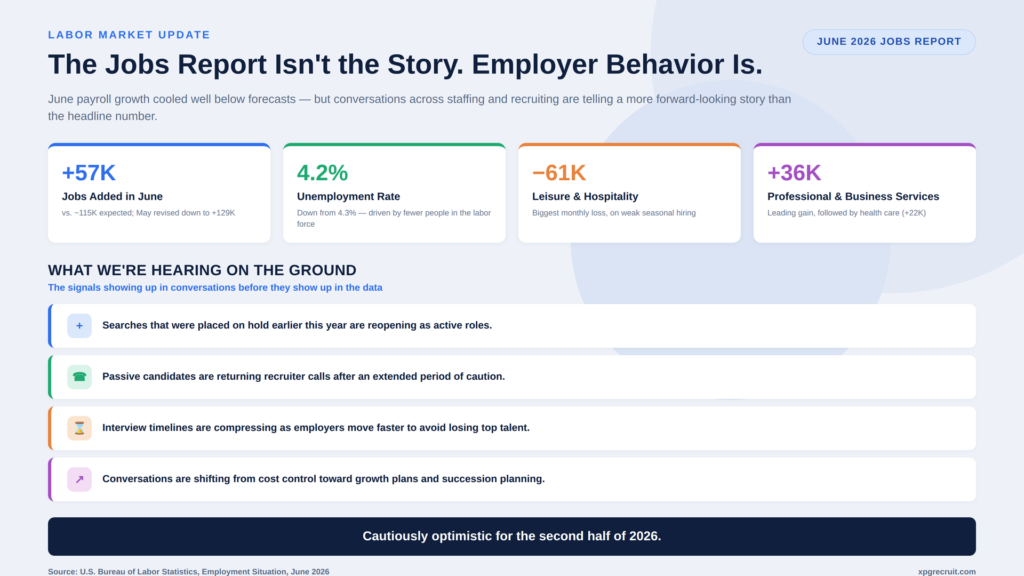
When the June jobs report was released, the headlines focused on slower-than-expected hiring. The U.S. economy added 57,000 jobs, well below the consensus forecast of approximately 115,000, while April and May payrolls were revised downward by a combined 74,000 jobs. The unemployment rate edged down to 4.2%, even as labor force participation fell, suggesting the improvement wasn’t driven solely by stronger hiring.
Those numbers tell an important story about where the labor market stands today.
Looking a little deeper, the report shows a labor market that’s becoming increasingly selective. Professional and business services added 36,000 jobs, continuing to outperform many other sectors, while leisure and hospitality lost 61,000 jobs, marking the largest monthly decline. Rather than broad-based hiring across every industry, the report reflects employers continuing to hire strategically where demand remains strongest.
That’s the data.
The more interesting question is what those numbers tell us about where the hiring market is headed.
At XPG Recruit, we spend every day talking with staffing executives, recruiters, sales leaders, hiring managers, and candidates across the country. Those conversations often begin shifting well before economic reports catch up. Increasingly, we’re hearing themes that support what we’ve been writing about throughout 2026. Confidence is gradually returning. Hiring activity is becoming more intentional. Companies are beginning to invest again—not aggressively, but deliberately. The June BLS report doesn’t necessarily reveal something entirely new. Instead, it reinforces many of the trends we’ve already been observing firsthand.
The Headline Only Tells Part of the Story
The report itself paints a balanced picture. While overall hiring came in below expectations, the labor market continues to show resilience. Employers are still adding jobs, but they’re doing so selectively, and the strongest gains remain concentrated in specific industries rather than spread broadly across the economy.
That distinction matters.
A single jobs report doesn’t automatically define the direction of the hiring market. Instead, it provides a snapshot of one month in time. Looking beneath the surface, we’re seeing organizations continue to prioritize critical positions while making more deliberate investment decisions than they did during the rapid expansion of previous years.
The Conversations Are Beginning to Change
One of the advantages of working exclusively in staffing and recruiting is that we often hear about shifts in the market before they show up in the broader data.
Over the past several months, we’ve noticed employers becoming more willing to revisit positions that had previously been placed on hold. Searches that once felt exploratory are becoming active searches. Conversations that centered around cost control earlier in the year are increasingly shifting toward growth plans, succession planning, and revenue generation.
Hiring managers remain thoughtful, but they’re also becoming more decisive once they identify the right candidate. In several recent searches, we’ve even seen interview timelines compress because employers recognize that waiting too long may mean losing top talent.
Those aren’t signs of a hiring boom.
They’re signs of growing confidence.
Candidates Are Responding Differently
The candidate side of the market appears to be evolving as well.
In our recent blog, The Quiet Return of Candidate Confidence, we discussed how experienced recruiters, sales professionals, and staffing leaders are becoming more willing to explore opportunities after an extended period of caution. That trend has continued.
Passive candidates are returning recruiter calls. More professionals are participating in multiple interview processes, and conversations have shifted beyond simply finding stability. Candidates are increasingly evaluating leadership quality, growth opportunities, organizational direction, and long-term career potential.
These are subtle behavioral shifts, but they often emerge before broader hiring trends become obvious. When candidate confidence begins to improve, it usually signals that people are becoming more optimistic about the opportunities available to them.
Our Hiring Outlook Still Holds
Back in January, our 2026 Hiring Outlook suggested that any recovery would likely be gradual and uneven rather than immediate or universal. Different industries would recover at different speeds. Some companies would begin investing months before others, while certain functions would become more competitive long before the broader market fully recovered.
Six months into the year, that outlook still appears to be holding true.
The June jobs report isn’t evidence that the hiring market has fully rebounded. Rather, it’s another data point supporting the direction we’ve been discussing throughout the year. The recovery isn’t happening all at once, but it is becoming increasingly visible through both the data and the conversations taking place across the industry.
Looking Ahead
Perhaps that’s the biggest takeaway from this month’s report.
The headlines tell us what happened.
The conversations help us understand what’s likely coming next.
Economic reports are invaluable, but they’re inherently backward-looking. Recruiters hear about expanding teams before new positions are posted. Sales professionals hear about hiring budgets before they’re finalized. Candidates begin quietly exploring opportunities before they officially enter the market. Those conversations provide context that numbers alone simply can’t.
For that reason, we remain cautiously optimistic about the second half of 2026. The June jobs report reflects a labor market that remains measured and selective. At the same time, gradually improving employer confidence, increasing candidate engagement, and the reopening of previously paused searches suggest there are encouraging signs beneath the surface that won’t necessarily be captured in a single month’s data.
It may not be arriving all at once, but it is moving forward. And for those of us in staffing and recruiting, that’s often where the most meaningful opportunities begin.